Case studies

What real integrations taught Heddle.

These case studies document where Heddle has been tested inside real products—what worked, what changed, and where the product/runtime boundary belongs. Some describe current research systems; others preserve lessons from historical deployments.

Integration retrospective

SlideX

Historical deployment · first third-party integration

A browser presentation workspace that integrated a conversational agent for creating and revising real decks.

What SlideX taught Heddle about becoming a product SDK.

In July 2026, SlideX deployed a Heddle-powered conversational presentation agent. The hosted product has since been retired as SlideX moved back toward local operation, but the integration became the pressure test that reshaped Heddle into a reusable SDK.

  • Integrated real presentation tools
  • Proved durable multi-turn conversations
  • Shaped Heddle's public SDK boundaries
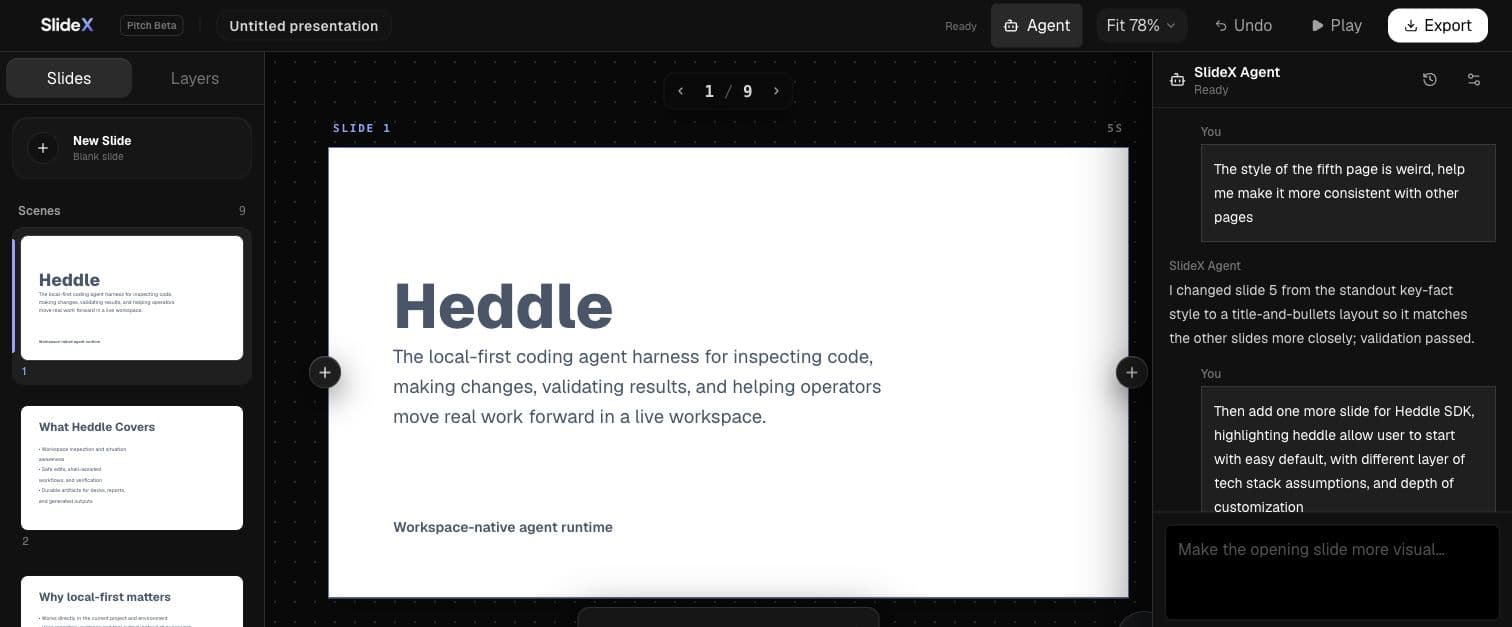
SlideX editor showing a presentation beside a multi-turn conversation with the SlideX Agent
Captured during the July 2026 deployment: a real SlideX conversation asks the agent to restyle a slide, add SDK content, and insert a section header.

Hosted execution proof

Lucid

Experimental deployment · observed hosted execution

An experimental delegated-discovery workspace where one personal Agent follows an Interest, checks for useful information, and returns grounded Findings or an explicit no-action outcome.

An agent that wakes after the user leaves.

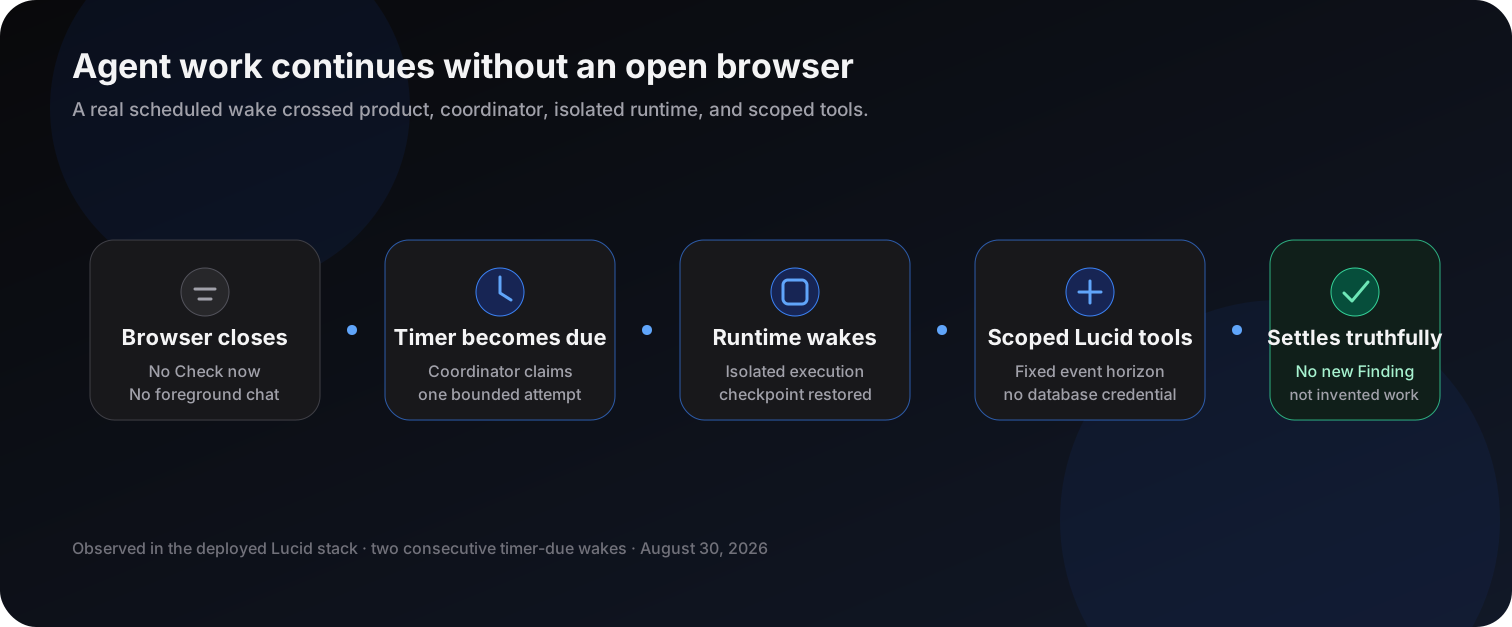
Lucid proved that a product-owned personal Agent could wake on schedule, enter an isolated Heddle runtime, inspect only a fixed product scope, and settle truthfully—even when there was no useful Finding to return.

  • Scheduled work without an open browser
  • Scoped product access without database credentials
  • Durable claims, recovery, and truthful settlement
Diagram showing a Lucid Agent waking on schedule after the browser closes and settling with no new Finding
The deployed proof crossed a timer-due Coordinator claim, managed isolated Runtime, fixed Lucid event horizon, scoped tools, and a truthful no-finding settlement without foreground interaction.